Part 1: What It Is, When to Use It, and Why It Is One of the Most Effective Respiratory Therapies
Respiratory disease is one of the most common causes of coughing, reduced performance, and discomfort in horses. Today, owners have access to a powerful and highly effective tool: nebulisation. This method delivers medication directly to the lower airways, providing rapid relief from symptoms and supporting long-term stabilisation in asthmatic horses.
This article is the first in a two-part series. It explains what nebulisation is, when it is used, and which scientific studies support its effectiveness. The second part will provide a practical, step-by-step guide on how to nebulise safely and effectively.
1. What Nebulisation Is and How It Works
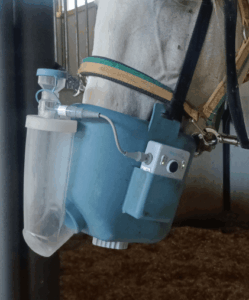
Nebulisation converts a liquid (solution or medication) into a fine aerosol that the horse inhales through a mask. Particles sized 2–5 microns penetrate deeply into the lungs, where they act directly on inflammation or mucus.
This differs significantly from “steam inhalation” in a stable, which mainly affects the upper airways.
Why nebulisation is so effective
- Targeted delivery of medication to the lower airways
- Rapid onset of action, often within minutes
- Minimal systemic side effects, especially with corticosteroids
2. When Nebulisation Is Appropriate
Nebulisation is recommended for most conditions characterised by inflammation, coughing, mucus production, or bronchoconstriction.
Common indications
- Mild and moderate equine asthma (MEA) – formerly IAD
- Severe equine asthma (SEA) – formerly RAO
- Allergic reactions to dust, mites, mould, or pollen
- Post-infectious airway inflammation – to support mucus clearance
- Horses sensitive to systemic medication
3. Solutions Used for Nebulisation
The choice of solution depends on the diagnosis and veterinary recommendation. Below are the most common and well-studied options.
Physiological Saline (0.9% NaCl)
- Hydrates airway surfaces.
- Softens and loosens mucus.
- Safe for daily use.
Hypertonic Saline (3–7%)
- Helps loosen thick mucus by drawing water into the airways via osmosis.
- Useful for short-term improvement of mucus clearance.
- Can irritate the airways and, in sensitive horses, may cause coughing or bronchospasm.
- Should be used selectively rather than as a routine treatment.
- Veterinary consultation is recommended if the horse shows marked coughing or has highly reactive airways.
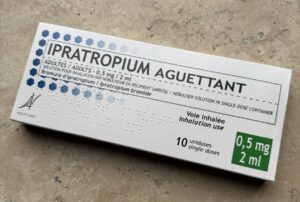
Bronchodilators (e.g., ipratropium)
- Dilate the airways.
- Useful during acute respiratory distress or before exercise.
The main bronchodilators used in nebulised therapy are ipratropium bromide, salbutamol and, less frequently, clenbuterol.
📚 Clinical data: Onset of action within 15–30 minutes; improves airway patency in asthmatic horses.
Corticosteroids (e.g. budesonide)
Among the most effective therapies for equine asthma.
- Strong anti-inflammatory effect.
- Very low systemic absorption.
- Must be prescribed by a veterinarian.
The most commonly used corticosteroids for equine nebulisation are budesonide, fluticasone and, to a lesser extent, dexamethasone.

Antibiotics / Antifungals
- Used only when a respiratory infection is confirmed through BAL cytology and culture.
- Never administered empirically or as a preventive measure.
- Formulation and dosage for nebulisation must always be determined by a veterinarian.
- Typically reserved for cases involving bacterial or fungal involvement identified through diagnostics.
Herbal solutions / essential oils
- Often irritate equine airways.
- No high-quality studies support their use in horses.
- Risk of bronchospasm or allergic reactions.
4. Expected Results
Proper nebulisation leads to in rapid, measurable improvements in most respiratory conditions.
Common benefits
- Reduced coughing.
- Lower, more stable resting respiratory rate.
- Less reactivity to dust or allergens.
- Improved exercise tolerance.
- Stabilisation of chronic respiratory issues.
5. Nebulisation as Part of a Complete Treatment Plan
Nebulisation is most effective when combined with management changes such as:
- steamed or soaked hay,
- low-dust bedding,
- excellent ventilation,
- reduced ammonia exposure,
- regular monitoring of respiratory rate,
- progressive exercise planning.
Veterinarians commonly recommend nebulisation following:
- clinical examination,
- BAL cytology,
- endoscopy,
- allergy testing where appropriate.
6. When Nebulisation Is Not Enough – When to Call a Veterinarian
Contact a veterinarian immediately if:
- breathing worsens during or after nebulisation,
- wheezing or whistling occurs,
- the horse develops a fever,
- nasal discharge turns yellow or green,
- symptoms persist or worsen over several days.
This may indicate infection or an acute asthma episode requiring prompt medical intervention.
🐴 Key Takeaways
- Nebulisation delivers medication directly to the lungs resulting in high efficacy.
- It is ideal for asthma, allergies, and chronic cough.
- Studies confirm improved mucus clearance, reduced inflammation, and better lung function.
- It is most effective when combined with environmental management.
Conclusion: Why Nebulisation Plays an Important Role in Equine Respiratory Care
Nebulisation is a safe, effective, and well-researched treatment for horses with respiratory disease. Scientific evidence strongly supports its use in equine asthma and allergic airway disorders. It provides rapid relief, reduces inflammation, and contributes to long-term stability, especially when combined with appropriate management.
This article is Part 1 of the series. In Part 2, you will find a practical guide covering:
- how to nebulise step by step,
- how to choose the right device,
- common mistakes to avoid,
- essential hygiene rules,
- how to integrate nebulisation with training.
Resources
📚Cha M. L., Costa L. R. (2017). Inhalation Therapy in Horses. Vet Clin North Am Equine Pract., 33(1):29–46. doi:10.1016/j.cveq.2016.11.007
📚Lavoie J-P, Leclère M, Rodrigues N, Lemos K, Bourzac C, Lefebvre-Lavoie J, Beauchamp G, Albrecht B. (2019). Efficacy of inhaled budesonide for the treatment of severe equine asthma. Equine Veterinary Journal. 51(3): 401–407. doi:10.1111/evj.13018
📚Bond SL, Greco-Otto P, MacLeod J, Galezowski AM, Bayly W, Léguillette R. (2020).
Efficacy of dexamethasone, salbutamol, and reduced respirable particulate concentration on aerobic capacity in horses with smoke-induced mild asthma, Journal of Veterinary Internal Medicine, 34(2):979–985.
📚E. Pistocchini, A. M. Carrillo Heredero, M. Mazan, L. Couëtil, S. Bertini & L. Calzetta (2025). Clinical efficacy of inhaled corticosteroids in equine asthma: A meta-analysis and number needed to treat. Pulmonary Pharmacology & Therapeutics, 88, 102342. DOI: 10.1016/j.pupt.2024.102342
Couëtil LL, Chilcoat CD, DeNicola DB, Clark SP, Glickman NW, Glickman LT. 2005. Randomized, controlled study of inhaled fluticasone propionate, oral administration of prednisone, and environmental management of horses with recurrent airway obstruction. Am J Vet Res. 66(10):1665–1674. doi: 10.2460/ajvr.2005.66.1665
📚Robinson NE, Derksen FJ, Berney C, Goossens L (1993). The airway response of horses with recurrent airway obstruction (heaves) to aerosol administration of ipratropium bromide. Equine Veterinary Journal. 25(4):299–303. doi:10.1111/j.2042-3306.1993.tb02967.x
📚Michelle L. Husulak, C. Manning, C. Epp, D. Montgomery, D. Meachem, R. Burgess (2018). Does antimicrobial therapy improve outcomes in horses with severe equine asthma and a positive tracheal wash bacterial culture? Canadian Journal of Veterinary Research, 82(3), 184–191. DOI: 10.18849/cjvr.82.3.184
📚C. J. Morales & L. R. R. Costa (2024). Chronic Cough and Hyperpnea: Clinical Approach to Equine Asthma. Vet Clin North Am Equine Pract., 40(2S), e21–e39. DOI: 10.1016/j.cveq.2024.09.001