

Types, Technologies, Particle Size and Practical Decision-Making (Part 2)
In Part 1 of this series we explained why inhalation therapy is among the most targeted treatments for equine lower airway disease.
This second article addresses a practical question:
Which nebuliser system is suitable for your horse?
Device selection should always be based on:
- A confirmed diagnosis
- Clear staging of disease severity
- Veterinary prescription of a specific medication
The medication determines the device – not the other way around.
1️⃣ Understanding the Diagnosis First
Equine asthma exists on a spectrum:
- Mild to moderate asthma
- Severe equine asthma
Diagnosis is typically based on:
- Clinical signs
- Endoscopy
- Bronchoalveolar lavage (BAL) cytology
The degree of inflammation influences:
- Whether inhaled corticosteroids are needed
- Whether bronchodilators are required
- Whether environmental management alone may be sufficient
Not every coughing horse requires inhaled medication.
Correct staging prevents over- or under-treatment.
2️⃣ The Three Inhalation Systems You May Encounter
For equine use, inhalation therapy systems fall into three categories:
- Vibrating mesh nebulisers
- Metered-dose inhalers (MDI) with spacer
- Compressor (jet) nebulisers
For most owners managing chronic disease at home, only the first two are routinely relevant.
Vibrating Mesh Nebulisers
(Liquid medication systems)
These devices use a vibrating membrane to convert liquid medication into a fine aerosol.
They are currently the most flexible home-based option for equine asthma.
Example Brands
🐴 Flexineb
Advantages
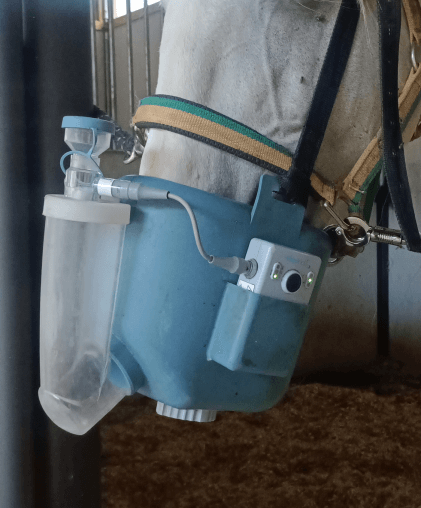
- Quiet operation
- Portable
- Low residual drug volume
- Suitable for corticosteroids and bronchodilators
- Widely supported in clinical practice
Considerations
- Requires strict cleaning
- Mesh membrane requires periodic replacement
- Higher initial cost
🐴 Hippomed Air-One
Advantages
- Designed for equine anatomy
- Portable mesh system
- Suitable for long-term therapy
Considerations
- Availability varies by region
- Cleaning and drying are essential to prevent contamination
When Mesh Systems Are Appropriate
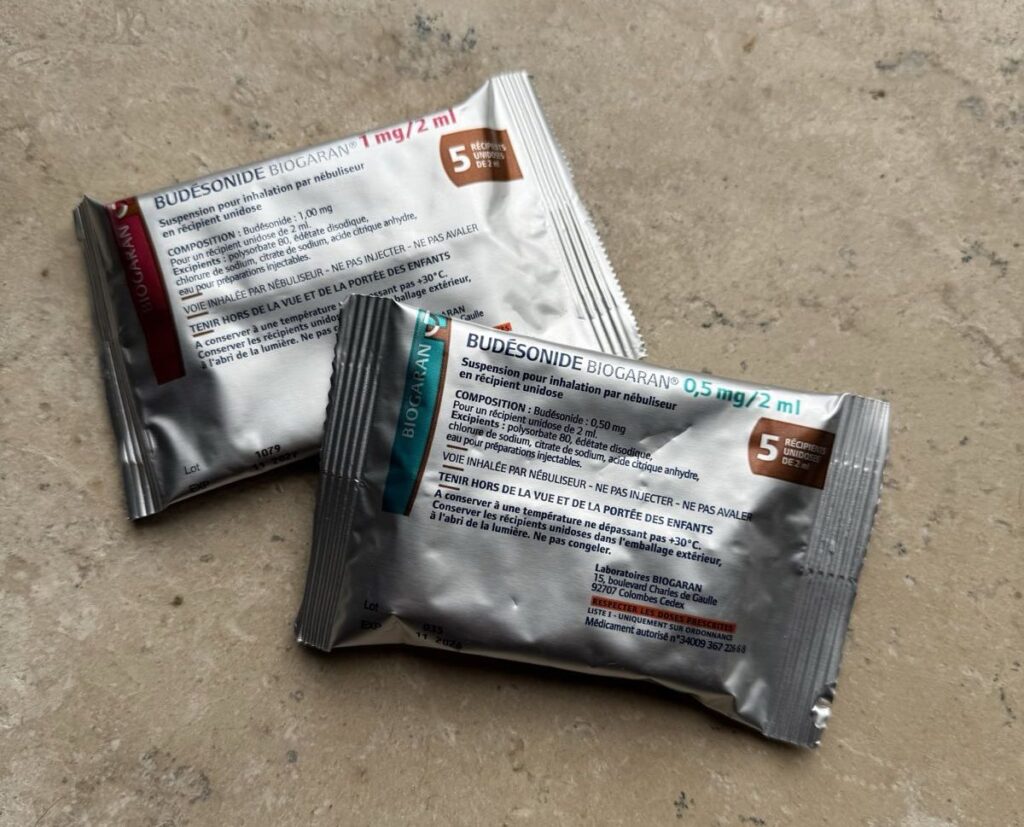
- Liquid budesonide
- Nebulised bronchodilators
- Isotonic saline
- Adjusted or combined protocols under veterinary guidance
Typical session length: 8–20 minutes.
They are ideal when flexibility is required.
Metered-Dose Inhaler (MDI) + Spacer Systems
(Pressurised aerosol delivery)
This system delivers a pre-measured dose of medication via a spacer mask.
It is not classic nebulisation, but it is a key component of modern equine inhalation therapy.
Example Brand
🐴 Aservo – Aservo EquiHaler
Advantages
- Pre-measured dosing
- Very short administration time (1–2 minutes)
- Licensed veterinary medicinal product
- Predictable withdrawal times
Considerations
- Compatible only with specific medication (ciclesonide)
- Less adaptable than liquid systems
- Cartridge replacement cost
Important Application Detail
For effective delivery:
- The mask must seal properly
- The horse must take several calm breaths after actuation
- Stress or shallow breathing reduces deposition
Spacer systems rely on correct technique just as much as nebulisers.
However, it appears that the manufacturer may have initiated the process of discontinuing Aservo EquiHaler, although this has not been officially confirmed, and its future availability therefore remains uncertain.
Compressor (Jet) Nebulisers
(Primarily hospital devices)
Common human medical brands include:
- Philips Respironics
- Omron
These systems:
- Are louder
- Produce variable aerosol output
- Have higher residual medication volumes
- Require longer treatment sessions
They are mostly used in veterinary hospitals.
They are rarely the optimal choice for long-term home management.
3️⃣ Practical Decision Guide
If your veterinarian prescribes:
- Liquid medication → choose a mesh nebuliser.
- Pressurised inhaler → use the recommended spacer system.
If your horse:
- Requires flexible dose adjustments → mesh system offers adaptability.
- Is stable on licensed corticosteroid therapy → spacer may be sufficient.
- Is competition active → spacer systems offer predictable dosing schedules.
4️⃣ Particle Size – The Critical Variable
For medication to reach the lower airways:
A particle diameter 1–5 μm is required
Optimal deposition often occurs at around 2–4 μm
- Particles of 5 μm deposit in the upper airway
- Particles smaller than1 μm are exhaled
Device engineering determines this. Particle size is more important than brand popularity.
5️⃣ Long-Term Cost and Sustainability
Mesh Systems
- Higher initial device cost
- Ongoing membrane replacement
- Greater flexibility in medication choice
- Potentially lower long-term medication cost depending on protocol
Spacer Systems
- Lower device complexity
- Ongoing cartridge purchases
- Fixed dosing structure
- Minimal equipment maintenance
Cost should be evaluated over months, not days.
6️⃣ Common Mistakes When Choosing
- Purchasing before veterinary consultation
- Selecting based on price alone
- Using human nebulisers without a proper equine mask fit
- Underestimating cleaning requirements
- Ignoring disease severity
Correct device selection improves compliance and clinical outcomes.
My experience
I have been using a Flexineb system for more than ten years and it has been one of the best investments I have made in my horse’s respiratory health.
In our case, daily management often consists of simple saline inhalation. During flare-ups, when a short course of inhaled corticosteroids is required, the system performs equally reliably.
With daily use, one medication chamber typically lasts around three months. Over the past decade, I have mostly replaced small parts damaged during handling and once or twice the battery.
The device has proven durable, practical and easy to use. For long-term management, consistency and simplicity matter – and this system has delivered both.
Conclusion
For most horse owners managing respiratory disease at home:
- Vibrating mesh nebulisers and spacer systems are the relevant options.
- Jet nebulisers are primarily hospital tools.
- Particle size and medication compatibility are more important than brand marketing.
- Diagnosis must precede device purchase.
In Part 3, we will focus on how to nebulise correctly, including step-by-step technique, hygiene protocols, and common errors that reduce therapeutic effectiveness.
🐴 Key Takeaways
- Always confirm the diagnosis before selecting a device.
- The medication determines the system.
- Particle size determines lung deposition.
- Mesh systems offer flexibility.
- Spacer systems provide speed and dosing precision.